Watch live streaming video from neilgaiman at livestream.com
Showing posts with label writing. Show all posts
Showing posts with label writing. Show all posts
Monday, June 27, 2011
Neil Gaiman: blogging, tweeting, possible projects and his writing process
Ok, so I'm on a bit of a Neil Gaiman kick right now. I'm enjoying his writing and love how involved he can get online with fans. The other day he did an interview as part of a tour celebrating and promoting the 10th anniversary of American Gods. This interview is great because he talks about how he uses the internet to promote and connect with fans and how it influences his writing.

Wednesday, June 15, 2011
Learning Outcomes
How fast time has gone by. I almost can't believe that the semester is over, but let me tell you that I am ready for a break. Next semester is my last semester of classes at BYU and in the winter I'll be doing my student teaching. I think that this class has been a great preparation for using tech when I'm teaching, and I've learned a lot about writing and research. So, as the semester ends, it's time to look at the learning objectives and see how I did. Our learning objectives were centered around three important aspects of writing in the digital age.
1. Consume. 2. Create. 3. Connect.
Consume: I've learned how to use the internet in conjuction with traditional libraries and databases to find what others are saying about the work I am studying. During the semester I've searched for information with Google, Twitter, Goodreads forums, fansites, and Diigo bookmarks just to name a few sources. The value to this is that we can filter our information by finding people who are invested in our research and have already done some of the work on their own. They can be great sources for finding information about a topic of research. This enhances the research we can do in the library with its databases of scholarly journals.
Create: I've learned that creating can be part of the process of discovery, but it also gives our research a valid outlet. Authentic projects have been the name of the game, and that is what we have done with our eBook. I've created content with my blogging and with my Diigo account that has helped me and could also be of use to other people who are trying to learn more about Douglas Adams or making eBooks or even using digital tools and media. By creating we add our part to a massive conversation and exchange of knowledge that is the nature of both the internet and scholarly writing. I didn't only consume information about my book either. I spent hours consuming information and learning about InDesign in preparation for the eBook we would be making. Blogs and youtube videos and social bookmarks were a great help with finding and consuming that information.
Connect: I've connected with many people this semester. First, I've never worked more closely nor been more involved with my classmates work as I have this semester. It has been great to see their blogs and learn about Borges or Comics or pig farming as the semester has gone by. Also, the level of collaboration that has taken place has had me emailing, chatting and pestering almost every one of my fellow students in the course as we tried to get this eBook done. It has been a great experience and I have learned a lot. Connecting with others? Well, as a class we have been connecting with others to share our work with them. I had several friends on facebook tell me they were interested in the book we've written and I also sent out a recommendation to some of my friends on Goodreads. Hopefully they will read it and love it and share it with others who are interested. This is the point of connecting. This is the way that all of our research and writing and hard work pays off in the end. Someone will find it useful and share it with others who will also find value in it. It's so exciting.
I think that I've done pretty well this semester. I've worked hard at getting my writing done and writing often. I did a lot of research and learned more than just writing skills. I think that the things I've taken from this class with be assets in my future career.
1. Consume. 2. Create. 3. Connect.
Consume: I've learned how to use the internet in conjuction with traditional libraries and databases to find what others are saying about the work I am studying. During the semester I've searched for information with Google, Twitter, Goodreads forums, fansites, and Diigo bookmarks just to name a few sources. The value to this is that we can filter our information by finding people who are invested in our research and have already done some of the work on their own. They can be great sources for finding information about a topic of research. This enhances the research we can do in the library with its databases of scholarly journals.
Create: I've learned that creating can be part of the process of discovery, but it also gives our research a valid outlet. Authentic projects have been the name of the game, and that is what we have done with our eBook. I've created content with my blogging and with my Diigo account that has helped me and could also be of use to other people who are trying to learn more about Douglas Adams or making eBooks or even using digital tools and media. By creating we add our part to a massive conversation and exchange of knowledge that is the nature of both the internet and scholarly writing. I didn't only consume information about my book either. I spent hours consuming information and learning about InDesign in preparation for the eBook we would be making. Blogs and youtube videos and social bookmarks were a great help with finding and consuming that information.
Connect: I've connected with many people this semester. First, I've never worked more closely nor been more involved with my classmates work as I have this semester. It has been great to see their blogs and learn about Borges or Comics or pig farming as the semester has gone by. Also, the level of collaboration that has taken place has had me emailing, chatting and pestering almost every one of my fellow students in the course as we tried to get this eBook done. It has been a great experience and I have learned a lot. Connecting with others? Well, as a class we have been connecting with others to share our work with them. I had several friends on facebook tell me they were interested in the book we've written and I also sent out a recommendation to some of my friends on Goodreads. Hopefully they will read it and love it and share it with others who are interested. This is the point of connecting. This is the way that all of our research and writing and hard work pays off in the end. Someone will find it useful and share it with others who will also find value in it. It's so exciting.
I think that I've done pretty well this semester. I've worked hard at getting my writing done and writing often. I did a lot of research and learned more than just writing skills. I think that the things I've taken from this class with be assets in my future career.
Our eBook has arrived

We decided to use Adobe's InDesign CS5 to compile and format our eBook into the ePUB and PDF formats. From the ePUB we converted to a MOBI format for Kindle and I have to say all three formats came out quite nice. Several different versions of our free eBook can be downloaded here. Also, if you are on Goodreads, you can download the book here. If you like it, please remember to give us a good rating.
So, what goes in to making an eBook with InDesign? It's not as simple as you think. I'll talk a little about our process.
Sunday, June 12, 2011
Works Cited page
I decided to get a jump on the work cited page, although we still haven't finished all of the regular chapters. I put this together based on what sources where in your final drafts. We are still waiting on a few chapters to be approved and sent back to the editing team. Other than that, the work cited on one or two chapters didn't have enough information to cite the pic used. If this is the case I sent you an email asking for more. I appreciate comments and collaborations. The work cited isn't set it stone, and if you can give it an edit, Nyssa, and help make it more uniform I would appreciate it..
Take a look at the work cited list for our eBook here.
Take a look at the work cited list for our eBook here.
Saturday, June 11, 2011
URGENT: read and respond ASAP
The design team will be working hard this weekend to try to have the eBook ready to launch on Monday by class time. Right now we are working and designing each individual chapter for the eBook. I believe that we have gotten past the few minor problems we were having and everything is looking good.
Now, the reason for the post is to show you all the Table of Contents I am making. This is the annotated Table of Contents that will be at the beginning of the eBook. It will look like this barring any changes, but the section and chapter names will have internal links to its proper place in the book. I had to take liberties with a few thesis statements, especially if you didn't provide the "tweethis," so look this over and find your annotation. If you don't like it or want to change it I need to know. Just make a comment on this post and include the changes or new thesis you would like me to put in the final version. Any other input is also appreciated. Thanks for taking the time to look at this.
Download the PDF here
Now, the reason for the post is to show you all the Table of Contents I am making. This is the annotated Table of Contents that will be at the beginning of the eBook. It will look like this barring any changes, but the section and chapter names will have internal links to its proper place in the book. I had to take liberties with a few thesis statements, especially if you didn't provide the "tweethis," so look this over and find your annotation. If you don't like it or want to change it I need to know. Just make a comment on this post and include the changes or new thesis you would like me to put in the final version. Any other input is also appreciated. Thanks for taking the time to look at this.
Download the PDF here
Wednesday, June 8, 2011
New chapter image
After talking with Annie Ostler and Ashley Nelson, we decided that my image probably wasn't going to work because of some small text the image contained. So, I decided to get a new image. I wanted something similar, but with less words or small text in it. I couldn't find anything I loved, so I took an image I liked and changed it a little for my purposes. I still have to figure out the right way to credit the original creator and acknolwedge that I changed it. Anyway, I thought I would put the image out here to see what everyone thinks about it.
 The original was done by Imooty and can be found on her flickr account here. It has a creative commons license and only requires attribution. So unless I get negative feedback this will be the picture.

Tuesday, June 7, 2011
Final Draft?
Alright, I think that I have my final draft ready to send to the editing team. Hopefully I didn't create too much work for them, but I sometimes forget to put in commas simply because they are there in my head and I don't realize that they aren't there. Anyone who would like to see my chapter can read it here, although I'm sure that you are all as busy as I am trying to finish everything and make it look nice. Good luck everyone! I'll send a Word version to the editing team in case that makes it easier for them.
As always, any pointers or other advice would be appreciated. It's not set in stone yet.
Good thing I finished. I just finished my Dr Pepper.
As always, any pointers or other advice would be appreciated. It's not set in stone yet.
Good thing I finished. I just finished my Dr Pepper.
Monday, June 6, 2011
Draft progress.
Ok, I think I've finished writing my rough draft now. I just need to trim the fat, tweak a few things and add the bio. I'm just going to post the link to the google docs and you can see how it looks on that. Tell me what you think of my picture I used and anything else you can think of.
Breaking Conventions: A Hitchhiker's Guide to Scholarly Research in a Digital Environment
Breaking Conventions: A Hitchhiker's Guide to Scholarly Research in a Digital Environment
I wasn't procrastinating . . . I just ran out of soda
 |
| photo by brent_nashville |
I don't know about you guys, but when I am sitting down to write a paper, or anything that will be longer than a page, I really love to have a soda or something else to drink. It isn't even the caffeine, although Dr Pepper is my drink of choice. Right now I'm taking a break from writing, but I have an open Shasta Black Cherry soda can on my desk. It's almost to the point that after so many minutes of writing I have to get up and get a soda or stop. Maybe I just do it to break the monotony.
How about you guys? Do you have any strange writing habits?
Friday, June 3, 2011
The three C's
Consume
- I consumed H2G2 in many formats: Audiobook, radio, book, tv
- Carlie discusses different ways of consuming and what makes a primary text
- Matt consumes literature in comic book format, is it legitimate?
- Amy has had success connecting with teachers and asking them about her novel
- Annie has connected with forums that focus on the personal relevance Toni Morrison's books have had for them
- Ashley and fanfiction
- my blog post on dead-end research
New Title
I think the title for my chapter is going to be Breaking Conventions: A Hitchhiker's Guide to Scholarly Research in a Social Environment
What do you think?
What do you think?
My Raw Rough-Draft
Breaking Conventions: Scholarly Research in a Social Environment
Douglas Adams, author of The Hitchhiker’s Guide to the Galaxy, is an expert at breaking conventions. When the book that defined his career was published in 1979, it was an instant success, and its popularity spread to all parts of the world. The key to Douglas’ success is the way he was able to break the conventions of the genre he was writing in while showing an understanding and appreciation for the same unspoken rules he was breaking. The result was an unforgettable galactic comedy. His success at this can be measured in the fact that these stories have been adapted for radio, book, audiobook, TV, movies and even a play. Douglas skill at the craft shines through in all formats, and his fans all over the Internet agree that no one can successfully imitate the way he writes.
There are certain unspoken rules in any genre that all readers pick up on implicitly which, without conscious thought, they use to compare a work with others and therefore determine its value. So, when Adam’s takes an unexpected turn right before satisfying the unspoken conventions his readers are waiting to find, we find it funny because we are pleasantly surprised. Douglas tips his hat to the same convention he laughs at, and we are in on the joke.
One character that meets conventions while breaking them is Marvin the Paranoid Android. Reading blogs and fansites online, I’ve seen that he is a favorite of many Adams fans. A chronically depressed robot who can’t stand humans or other robots, and is constantly complaining, “Life, don’t talk to me about life.” Who wouldn’t laugh? We find value in Marvin as a comical character because he meets one important convention of the Science Fiction genre. Most science fiction include androids in some way in their stories. Quite often these androids are super intelligent and are dealing in some sense with the ability to act and feel emotionally like a human. Data from Star Trek: The Next Generation is one popular example of this. Classic examples in literature are Asmiov’s Robot series, beginning with I Robot and Philip K. Dick’s Do Androids Dream of Electric Sheep? All of these address the issue of combining robot intelligence with human characteristics such as emotion. We love Marvin because he fits this category. Marvin has the largest “brain” in the galaxy and calculates complicated problems lightning-fast--when he feels up to it. Douglas breaks conventions by parodying this idea and showing what the most pathetic of human emotions would look like in a robot. We, the readers, like this because we see ourselves and don’t have to worry about intelligent and emotionally stable robots.
Breaking conventions can be a risky business if someone wants their work to be taken seriously, especially when dealing with long-standing traditions like the Science Fiction genre or even scholarly research and writing. It is, if I may be permitted to mix metaphors, like walking a tightrope that is over thin ice. One misstep and you fall through. If writers move too far away from the conventions of their genre, they run the risk of not being taken seriously or appearing to be careless in their craft. On the other hand, those who play it too safe compromise their initial purpose to create something fresh and new. To successfully break conventions, it is necessary to show a mastery of those same rules you are breaking. Douglas did this perfectly in his writing. There is no doubt his jokes are carefully crafted to address convention and turn it on its head. By meeting the requirements his readers expected he was able to break them with greater impunity. Nevertheless, Adam’s books are not often seen as literature worth studying and writing about in schools or scholarly works. The question remains, How do you break conventions while creating something that can be taken seriously in scholarly reasearch and writing?
Consume
Connect
Create
Friday, May 27, 2011
An e-book can be many things
I have to say that I've been at a loss when thinking about what my class can do with an ebook for our final project. Some want to write from an LDS perspective, which is fine, and something that would be worth doing. I just have a hard time getting on-board with the idea, partly because I don't know how I could fit the Hitchhiker's Guide to the Galaxy into a project like this.
I've been thinking more along the lines of what Bri has proposed in her post. I think that the best way to combine our novels into one coherent book is to write about our own digital literary research and combine the process with writing about our literary work that we've been studying. I think this will serve our authenticity requirement, as we can make it available to those interested in doing similar work, having shown processes and tools for research 2.0.
I won't cover everything that Bri talked about, but I do think I have an answer to her question about scope and how we can do an e-book with the time that is left in the term. An e-book can be many things. Its only requirement is that it be digital and consisting of a theme that binds it all together. We don't have to make fancy flash-powered animation of page turning. It can be simple. I think that the best way to do this is with a wiki. The menu on the side can be the table of contents and we could even have a topical guide of sorts that gives links to all 'chapters' talking about certain topics of research. On the wiki we can include photos, video, and other things that a kindle format would not allow. We can also submit the link to groups and projects like teachers and the DPLA so they can see the use of multimedia and web2.0 in modern-day research.
I've been thinking more along the lines of what Bri has proposed in her post. I think that the best way to combine our novels into one coherent book is to write about our own digital literary research and combine the process with writing about our literary work that we've been studying. I think this will serve our authenticity requirement, as we can make it available to those interested in doing similar work, having shown processes and tools for research 2.0.
I won't cover everything that Bri talked about, but I do think I have an answer to her question about scope and how we can do an e-book with the time that is left in the term. An e-book can be many things. Its only requirement is that it be digital and consisting of a theme that binds it all together. We don't have to make fancy flash-powered animation of page turning. It can be simple. I think that the best way to do this is with a wiki. The menu on the side can be the table of contents and we could even have a topical guide of sorts that gives links to all 'chapters' talking about certain topics of research. On the wiki we can include photos, video, and other things that a kindle format would not allow. We can also submit the link to groups and projects like teachers and the DPLA so they can see the use of multimedia and web2.0 in modern-day research.
Thursday, May 26, 2011
MLA Bibiliography and Borges
- I've been interested in Rachel's search for things about Borges, so I decided to see what I could find in MLA International Bibliography.
- MLA Bibliography is a great bibliography of articles, journals, books and even chapters of books going back to the 1920's
- I originally looked in the MLA Bibliography trying to find a great article in Spanish that I might be able to translate for Rachel, something pertaining to her search about art and Borges. I didn't end up finding anything that looked interesting in Spanish though. I used the adnvanced search options putting in Borges name and words in Spanish and in English using the OR boolean operator. I got back many options but using the peer reviewed tab, I found a useful article online with a PDF and found the reference to it in the BYU library.
- Baler, Pablo. "The Subconcious of Civilization: An Interview with Lilian Porter." Sculpture (U.S.A.). 20.1 (2001). 26-41.
- Lilian Porter talks about her art and how it has been influenced by literature, especially by the writings of Borges and Carroll.
- I'm not positive if this will help Rachel, but it seems to fit with what she has talked about with her research on artwork and Borges and also her plans to maybe submit something to the DPLA project. It didn't help her get into a article written in Spanish, but hopefully it is something that she can use.
Researching ideas on Humor and The Hitchhiker's Guide to the Galaxy in ERIC
- I searched the ERIC database in hopes that I could find something on either The Hitchhiker's Guide to the Galaxy or even just ideas about teaching humorous texts in the classroom.
- ERIC (Education Resource Information Center) is a database of indexes and abstracts of many educational journals and reports after 1967.
- I accessed ERIC through EBSCO on the BYU library wesite. My intention was to see if anything has been written about using Hitchhiker in classrooms. I didn't find anything, so I searched more generally for articles on humor in the language arts classroom and humor AND English. This yeilded many resulsts and I was able to peruse the abstracts of the articles to find out which article might suit my needs. The article I found wasn't available but clicking the get@BYU button, I was able to find a pdf version on ProQuest.
- Goebel, Bruce A.. "Comic Relief: Engaging Students through Humor Writing." English Journal 98.6 (2009): 38-43.
- Goebel writes about the benefits of studying humor as a way to help students become engaged in learning and its use as a vehicle to teach grammar, language analysis, public speaking, and many other important aspects traditionally required in the study of language arts.
- I liked this article for two reasons. First, it gave some great general ideas for teaching humor in the classroom which I could apply to Hitchhiker. Second, it talks about several ways humor is produced which gave me some new ideas and confirmed others that I already had as correct.
Wednesday, May 25, 2011
Time is an illusion. Wasted time doubly so
At least, that is how I feel about the opportunities available by blogging our research process. In the old days, with traditional methods of research and writing, if I were to research something that ultimately led to a dead end I would have been frustrated and disappointed about all of that wasted time. Not so with this blog. I can talk about the process and my thoughts behind it and it serves a purpose and guides me to the next part of my research. This post is about what I learned and what I think about the possible connection between Douglas Adams' Vogon poem and Lewis Carroll's Jabberwocky.
The answer is a strong maybe in my mind.
The answer is a strong maybe in my mind.
Saturday, May 14, 2011
Review of Rainbows End
 Rainbows End by Vernor Vinge
My rating: 3 of 5 stars
Vinge's Rainbows End is a good book that he just didn't seem to be able to tie up completely at the end. I really enjoyed this book. I thought that some of the themes he addresses and the futuristic world that he creates were quite good. The idea of people who wear their computers and are always connected, experiencing an augmented view of reality is one that is exciting and exotic, yet not too far-fetched. The issues with this book are the ways he connects the two plot lines. I thought that both plot lines were good but so different from each other that you almost have to change mindset when switching to the other story. Vinge doesn't give enough closure for my taste on the secondary plot line and this left me feeling a little dissatisfied. I want to know more. That said, I thought this was a good book and one that I would recommend to friends and family who enjoy SciFi. Vinge has a few misses but when he gets it right in this book I really enjoyed it.
View all my reviews
Friday, May 13, 2011
I'm blogging in my Writing About Literature class?!
 |
| image by Blogging Librarian |
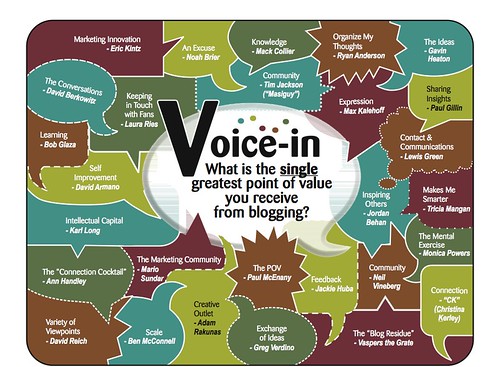
The one question I've asked myself is why this class is hiding in a writing about literature section if it is so much more than that. Forget the advanced writing requirement. I would have taken this class on my own if I'd have known it existed. I think that if this class were advertised better, there would be students lining up outside of Dr. Burton's office to take it. This type of writing is relevant because it has a larger audience than one person, and that is what makes the class so enjoyable. Without explicitly asking, I have come to the conclusion that this class must be a pilot program to see how it would work, if it is worth doing at all.
I may be off with this, but I think that most people in this class have found it to be a good one, and one with definite benefit. So why is it hiding in the English 295 category? Could it be possible to have this class taught regularly under its own category? This would advertise it to students and let them know that this type of writing class is available to them. I'm sure that many would prefer this class to many other writing classes offered at BYU.
I was thinking about this today as I left class and was hit by a great idea. Our collaborative project for the semester could be to help push this class out of the pilot program and into the regular curriculum. Why don't we, as a class, prepare a presentation that uses the skills we are learning to show the powers that be at BYU what exactly the value of this class is, and how we, as students, feel about having this class available to us?
What do you think? Would this be something worth doing? I feel that it has real-life value with a possibility of real-life results. I haven't taken the idea much further than this. I just thought I'd throw it out there to everybody else to see what they have to say on the matter.
Wednesday, May 4, 2011
Quick and Dirty Tips ™
Anyone who regularly writes would do well to make Grammar Girl a part of their media consumption. Grammar Girl's podcasts offer quick writing tips focused on different aspects of grammar and how to apply them in your writing. Her podcasts are focused on a new concept each time, and she presents them in a concise and entertaining manner that makes her podcast a great experience and a quick listen. This podcast is very well done and is a good addition to any who already listen to other podcasts and a great starting point for people who have never tried them before.
Below is a link to a website offering minilessons on a variety of topics. Under the Writing & Education tab you will find the link for Grammar Girl's website where you can listen to her blogs or read the transcripts provided. I recommend subscribing to Grammar Girl's podcast and taking advantage of her excellent advice.
http://www.quickanddirtytips.com
Below is a link to a website offering minilessons on a variety of topics. Under the Writing & Education tab you will find the link for Grammar Girl's website where you can listen to her blogs or read the transcripts provided. I recommend subscribing to Grammar Girl's podcast and taking advantage of her excellent advice.
http://www.quickanddirtytips.com
Tuesday, May 3, 2011
Times, They Are A-Changing
First, I can't say these words without thinking of one of my all-time favorite Bob Dylan songs, which I feel is appropriate considering the aims of this blog and what I will be talking about.
Alright, times are definitely changing in the world of writing. I have been thinking about what Matt Harrison said about the New York Times and the how distribution of news and mass media is changing. Also, I liked Nyssa Silvester's comments and the link she gave to a website talking about the nature of e-book publishing and why it sometimes can cost more than a paperback version of the same book. I was browsing that website a little bit when I was struck with how much the publishing and writing world has evolved in this new digital age. It truly is the time of change and new models of business for writers.
Freelance writing seems to be the order of the day for most websites and even magazines lately. The old model of the traditional nine-to-five, cubicle-dwelling writer is quickly dying away. The nature of the beast is changing and writers find themselves more able to work from home and write for a large number of clients. This creates a great opportunity for many aspiring writers but also a lot of competition as thousands, if not millions, of writers are all seeking to sell their skills as freelancers. I think this is a great thing that will improve diversity in the field and create a new model that can be both beneficial for writers and their employers.
Related to the freelance writer, is the self-publisher. Self-publishing can be done through websites like Lulu or Amazon and can be done in paper or electronic format. This offers a huge opportunity for authors who are struggling with agents and publishers in order to get their texts out to the public. Whitman began publishing Leaves of Grass with his own money and was so successful that he was later picked up by someone. This has happened in recent years with authors like Richard Paul Evans when he published The Christmas Box on his own. I even have a friend working on publishing a graphic novel he has written and drawn through Lulu. It's quite an exciting world for writers right now. The digital world offers a great opportunity for self-publishing, again, improving an old model of business to fit in a new digital world.
I have marked a couple of sites in my Diigo account under the tag "writing." As I find more on the subject I will mark it in Diigo under this tag. Feel free to check out what I've seen by following the link or clicking on the writing tag in my Diigo stream in the column to the right.
Subscribe to:
Posts (Atom)