I read this book when I was in high school but had to add it to my goodreads shelf. Anybody who enjoyed the movie Jeremiah Johnson will absolutely love Fisher's novel. The amount of detail in this book really transports you into the world of the mountain man. After all of these years, I still remember the descriptions of food and everyday processes the protagonist goes through. But the book is so much more than that. It is about a man who lives in an untamed world, far from any comforts or civilization, but he is happy. That is until his Indian wife and unborn child are murdered by some warriors from another tribe. Then, he wanders the wilderness seeking vengeance against those who stole away his love and happiness. Very good stuff.
The other day I found some groups about Douglas Adams and the Hitchhiker's Guide to the Galaxy on Google and Goodreads. Part of the way I want to research Adams' skill with comedy is to connect with others who love his works and hear what they have to say about it. So, I used the discussion sections on these groups and posted this to them.
"The first time I read Hitchhiker's Guide, I was blown away by Adams' uncanny ability to write comically. His books are so memorable largely because of Adams' skill with humor and his great one-liners.
What do you think? How does Adams do it? What is it about his writing that tickles our funny bone every time?"
I have put this question to three different Douglas Adams fan groups now (it has been a challenge to find good active fan pages. I mostly find blogs and other types of websites). This morning I had some emails alerting me that I've received a couple of answers to my question. Both have mentioned reasons why they find Douglas Adams so funny and have given me new insights into his writing style. I can't wait to see what other people have to say.
It can be argued, I think, that a book's importance can, in part, be measured by the type of impression it leaves upon society after it has been written. There is, of course, the immediate effects while people are still excited about a given work, but there are also longer lasting impacts that truly show how important a book has been to our culture. Granted, these influences are not always profound or important, but they do exist and they are important for some people. I'm talking about something more than Twilight fame. Twilight has had its moment, but I don't think it will last, or ever have a following like the Lord of the Rings or other stories. Part of my exploration of Hitchhiker's Guide to the Galaxy is going to be on the way it has influenced our culture and how it has remained relevant and popular even after more than 30 years.
For this post I want to talk about Towel Day. Towel Day began May 25 2001, a mere two weeks after Douglas Adams' untimely death. It has since been a tradition for fans everywhere to carry their towels with them every May 25 to celebrate Adams' life and his genius and creativity as a writer.
For those who aren't familiar with the Hitchhiker's Guide to the Galaxy, towels were named in the stories as being one of the most valuable possessions a interstellar traveler could have. This is what the Hitchhiker's Guide says:
"A towel, it says, is about the most massively useful thing an interstellar hitchhiker can have. Partly it has great practical value. You can wrap it around you for warmth as you bound across the cold moons of Jaglan Beta; you can lie on it on the brilliant marble-sanded beaches of Santraginus V, inhaling the heady sea vapors; you can sleep under it beneath the stars which shine so redly on the desert world of Kakrafoon; use it to sail a miniraft down the slow heavy River Moth; wet it for use in hand-to-hand-combat; wrap it round your head to ward off noxious fumes or avoid the gaze of the Ravenous Bugblatter Beast of Traal (such a mind-bogglingly stupid animal, it assumes that if you can't see it, it can't see you); you can wave your towel in emergencies as a distress signal, and of course dry yourself off with it if it still seems to be clean enough . . . any man who can hitch the length and breadth of the galaxy, rough it, slum it, struggle against terrible odds, win through, and still knows where his towel is, is clearly a man to be reckoned with."
In honor of Douglas Adams, I am going to carry my towel with me and of course tell everyone who asks about one of the most entertaining authors that I have read. I also wanted to write this post to share with everyone who comes across it so that they too can share the love of humor, Science Fiction, and hitchhiking.
Here is a short video talking about Towel Day
This is a Google Doodle done by Vinesh, a student at Lincoln Praire School, where they will be reading Vogon poetry to celebrate Towel Day. Google Towel Day Logo.
Desktop backgrounds by Travis Avery to celebrate Towel Day 2011
Lastly, Towel Day will also be celebrated in Second Life at Milliways, the restaurant at the end of the universe
If any of this made absolutely no sense to you, please, do yourself the favor and go down to your nearest library or bookstore or get onto Amazon or iTunes and buy this book. You'll laugh your way through it and have a more light-hearted look at Life, the Universe and Everything.
I really loved this story. Gaiman blends the mythology of multiple cultures into a melting pot of gods and magic appropriate for the demographics of the United States. The old guard vs. the new guard of gods and fairy-tale creatures are on the verge of a mythological battle which represents a paradigm shift of belief and worship in the United States, and Shadow, a regular, unassuming man, gets caught in the middle.
This novel is a very fun and quick-paced read. Gaiman keeps his story balanced between good action and mystery, which keeps you on your toes, and character development which shows the humanity of even the most barbaric of gods, which lets you really feel for the characters and enjoy their triumphs.
This is a novel for adults, with some harsh language, but the sex and violence isn't too explicit. I'd recommend this book to anybody who enjoys fantasy or mythology.
p.s. I listened to the audio version of this book. The narrator is perfect for this novel. Very well done.
. . . I like the whooshing sound they make as they fly by."
---Douglas Adams
I'm having trouble deciding how I want to approach The Hitchhiker's Guide to the Galaxy. I'm trying to blog my processes of research and what I am learning, and tangle with the text in a literary way. The problem is, I'm not sure how I want to approach this. One idea is to look at the humor of the book and Douglas Adams, and analyze how he creates humor and why it works. This idea appeals to me because it is something new for me, and I think I could learn quite a bit about the craft of comedy. Another approach that I am considering is to look at the ways the book has influenced pop culture and how the book has stayed alive in the hearts of the general public. This will be fun because I can look at how people consume the book and create their own content in order to celebrate Adams and his Galaxy. Lastly, I could study how this book has remained relevant in our digital and scientific culture, even 32 years after it was published. This is a rare thing for a Science Fiction novel and even more surprising when you think of more serious Science Fiction novels that are terribly outdated merely because they failed at predicting the future of technology and science.
I am sure I would enjoy any of these options, but I'm not sure which would be most profitable for me to study. I know that in a way these ideas are interconnected, but to talk about all three would be too general of a topic.
What do you think I should do? Leave comments and tell me which idea sounds the most interesting? Any input will be appreciated. I can't promise to follow your suggestion, but I will promise to take it into consideration.
I don't often read books like Crowdsourcing, but I found Jeff Howe to be an engaging writer who knows how to tell engaging stories to explain his theories on how to use the crowd in business. There are a few places that feel a little repetitious and dull, but Howe mostly delivers a solid message in an way that I found entertaining. My recommendation: Don't read this book word for word. Skim it, browse it, read it like a manual of sorts and you'll pick up the message without getting bogged down it similar stories or parts you don't find interesting.
I'm so excited for June to come fast. No, it's not because we finish Spring term. It is because Cinemark will be showing, for one night each, the extended versions of the Lord of the Rings Trilogy, and I got my tickets to see The Fellowship of the Rings.
Having talked in class about different ways to consume books, I began thinking about other movie adaptations and which ones have been good and which have been disgustingly bad. Here is a list of some of my favorite movie adaptations from books that I have read.
This iconic '80's movie starring Cary Elwes and Robin Wright is an adaptation from William Goldman's book by the same name. What I love about this book adaptation is that although the movie doesn't contain every scene from the book, what it does contain is surprisingly accurate. Even the grandfather reading the story to his grandson reflects how Goldman tells his story. This is refreshing in an industry that often takes liberties with the story lines they are adapting, resulting in a final product that resembles the original in name alone.
I think that many people don't realize that this move starring Marlon Brando as Don Corleone was originally a book by Mario Puzo. Although Puzo's book details much more than you see in the first movie, The Godfather tells the essential story of the Corleone family and their workings in the dark, yet honor bound world of the Italian-American mafia. This movie has become Hollywood's ultimate example of the mafia and is constantly alluded to in movies and TV programs. This is one of the must-see's in the world of cinema.
Richard Chamberlain stars in this mini-series that successfully takes James Clavell'sShogun to a new audience via TV. This mini-series lasts about 9 hours but is well worth the time for anyone interested in the exploration period, feudal Japan or simply a great story. The story told here is one of love, politics, isolation, religion and betrayal. It is very compelling, with excellent actors (including a surprising tie-in for this post). The Portuguese pilot is played by non other than John Rhys-Davies, also known as Gimli, the dwarf, in The Lord of the Rings Trilogy.
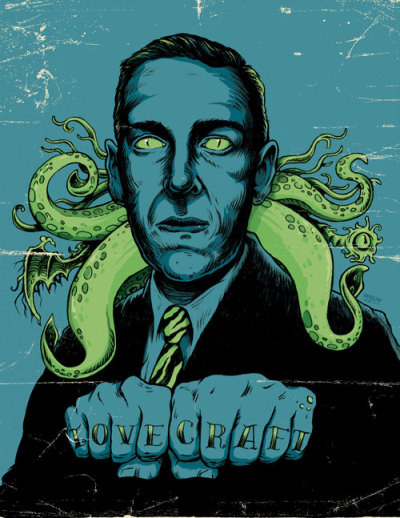
I was reading Ben Wagner's post "I'll never be able to read everything I want" this morning, where he talks about the impossibility of consuming all media that is created, and it reminded me of a conversation I had with my brother and his girlfriend about a week ago. During this conversation, my brother and his girlfriend mentioned H.P. Lovecraft, which got about as much of a response from me as they could get from a rock, because I had no idea who or what H. P. Lovecraft is. After staring at me in open-mouthed shock, they exclaimed how is it possible that I am an English major and have never read any Lovecraft. I, of course just laughed at them. "You can't read everything out there that someone thinks is worth reading." At this point, I had never even heard of H. P. Lovecraft, so they explained to me that H.P. Lovecraft practically started modern Horror--a genre that I am not very interested in. It did make me curious to remember the incident and his name though.
I began to encounter H. P. Lovecraft in other places. Having remembered the name H. P. Lovecraft, it made me smile when Vinge makes a reference to him in Rainbows End when talking about one of the belief circles in the library. It seems that maybe Lovecraft had enough influence to get remembered in Vinge's novel set around 2025. So, after reading Ben's post and remembering my brother and his girlfriend, I decided to check him out on wikipedia. Going down the page I learned for the first time that H.P. Lovecraft is a person and not a sub-genre of horror like I had originally thought. I was also amused to see that Lovecraft was quite fond of the idea of Forbidden Knowledge, a figure popular in one of the belief circles of Vinge's Rainbows End. Lovecraft has also inspired a lot of music, movies and literature with his horror and strange fiction. Learning these connections was kind of fun for me, but I doubt that I will ever get around to reading his work. And that is OK.
What is the point of studying English in college anyway? Can I consider it an education if I've never read H. P. Lovecraft or Lord of the Flies or any Steinbeck? Of course I can. The way I see it, English isn't about who can read the most books. It's about communication and art. We learn better communication by learning to write and express ourselves and also learning to analyze and understand what others are trying to say through their own writings. We learn the art of language by appreciating and studying what makes literature artistic and what aesthetic value it has to offer. Then, those that are especially good, can combine the two aspects and create something themselves that is both well communicated and artistic. That is how I view my college education.
What do you think? Should I try to read everything? Can we call ourselves English majors or lovers of literature if we haven't read everything on the official canon of literature? What is the point of the study of language? Leave me some of your comments. I'd love to see what you think.
p.s. I've tagged some Lovecraft info in my diigo account. Check that out on the right if you want to know more about him.
 Mountain Man by Vardis Fisher