Showing posts with label Rainbows End. Show all posts

Saturday, May 14, 2011

Review of Rainbows End

Rainbows EndRainbows End by Vernor Vinge

My rating: 3 of 5 stars


Vinge's Rainbows End is a good book that he just didn't seem to be able to tie up completely at the end. I really enjoyed this book. I thought that some of the themes he addresses and the futuristic world that he creates were quite good. The idea of people who wear their computers and are always connected, experiencing an augmented view of reality is one that is exciting and exotic, yet not too far-fetched. The issues with this book are the ways he connects the two plot lines. I thought that both plot lines were good but so different from each other that you almost have to change mindset when switching to the other story. Vinge doesn't give enough closure for my taste on the secondary plot line and this left me feeling a little dissatisfied. I want to know more. That said, I thought this was a good book and one that I would recommend to friends and family who enjoy SciFi. Vinge has a few misses but when he gets it right in this book I really enjoyed it.


View all my reviews

Monday, May 9, 2011

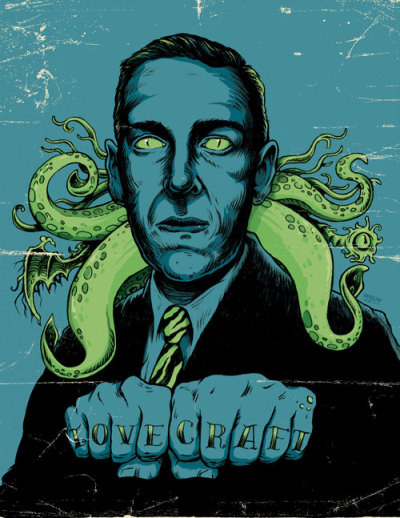
H.P. Lovecraft, Forbidden Knowledge and the English Major

http://pinkymcfatfat.tumblr.com/post/1357234795
I was reading Ben Wagner's post "I'll never be able to read everything I want" this morning, where he talks about the impossibility of consuming all media that is created, and it reminded me of a conversation I had with my brother and his girlfriend about a week ago.  During this conversation, my brother and his girlfriend mentioned H.P. Lovecraft, which got about as much of a response from me as they could get from a rock, because I had no idea who or what H. P. Lovecraft is.  After staring at me in open-mouthed shock, they exclaimed how is it possible that I am an English major and have never read any Lovecraft.  I, of course just laughed at them.  "You can't read everything out there that someone thinks is worth reading."  At this point, I had never even heard of H. P. Lovecraft, so they explained to me that H.P. Lovecraft practically started modern Horror--a genre that I am not very interested in.  It did make me curious to remember the incident and his name though.

I began to encounter H. P. Lovecraft in other places.  Having remembered the name H. P. Lovecraft, it made me smile when Vinge makes a reference to him in Rainbows End when talking about one of the belief circles in the library.  It seems that maybe Lovecraft had enough influence to get remembered in Vinge's novel set around 2025.  So, after reading Ben's post and remembering my brother and his girlfriend, I decided to check him out on wikipedia.  Going down the page I learned for the first time that H.P. Lovecraft is a person and not a sub-genre of horror like I had originally thought.  I was also amused to see that Lovecraft was quite fond of the idea of Forbidden Knowledge, a figure popular in one of the belief circles of Vinge's Rainbows End.  Lovecraft has also inspired a lot of music, movies and literature with his horror and strange fiction.  Learning these connections was kind of fun for me, but I doubt that I will ever get around to reading his work.  And that is OK.

What is the point of studying English in college anyway?  Can I consider it an education if I've never read H. P. Lovecraft or Lord of the Flies or any Steinbeck?  Of course I can.  The way I see it, English isn't about who can read the most books.  It's about communication and art.  We learn better communication by learning to write and express ourselves and also learning to analyze and understand what others are trying to say through their own writings.  We learn the art of language by appreciating and studying what makes literature artistic and what aesthetic value it has to offer.  Then, those that are especially good, can combine the two aspects and create something themselves that is both well communicated and artistic. That is how I view my college education.

What do you think? Should I try to read everything?  Can we call ourselves English majors or lovers of literature if we haven't read everything on the official canon of literature?  What is the point of the study of language?  Leave me some of your comments.  I'd love to see what you think. 

p.s.  I've tagged some Lovecraft info in my diigo account.  Check that out on the right if you want to know more about him.

Sunday, May 8, 2011

The Dilemma: To lose my mind or to lose my voice

First, to read my thoughts on Vinge's Rainbows End, as a complete work, follow the link here

Robert Gu, early in the book, finds himself with a dilemma of sorts, in regards to his Alzheimer's disease and the cure: Stay sick and die a famous poet who had Alzheimer's, or get better but lose your talent for poetry. Unfortunately for Robert, the decision has been made and the question answered before it was even asked.  Robert, a legend in the world of poetry, had been suffering from Alzheimer's and dying.  The cure for this degenerative disease has restored his mind, but it could not do so without some side-effects.  Being capable of coherent thought and memory, Robert wants to continue his works of poetry by writing about his fall and rise from Alzheimer's  There is only one problem, Robert has lost his talent to make the words sing.
 
The dramatic question in Robert's plot line is whether he will get his talent back or can he learn to accept his new life and his new-found affinity for technology.  Robert's loss change his fundamentally and as the book progresses, he becomes a person that people can actually consider pleasant company.  This is a slow, unintentional progress for Robert but slowly develops as he learns to accept his circumstances and be content with the choice that was taken for him. 

I find it interesting that, only after he truly learns to be happy with what ability he has in his new life, Robert is presented with the idea that he might have his cake and eat it too.  At the end of the novel Robert finds himself wondering if he might not be able to have both his poetic genius and his knack for technological things.  Vinge leaves this as an open question.  I think he knows that technology and beauty do not have to be separate entities, and this is the true epiphany Robert has as the novel closes. 

Tuesday, May 3, 2011

Looking Without Seeing

I've been enjoying Vernorn Vinge's Rainbows End during the last few days.  It is a SciFi novel, set in the not-so-distant future as an old man, newly recovering from Alzheimer's and any number of other illnesses, tries to adjust to life where technology and everything else are virtually inseparable.  Poor Robert Gu is a 75 year old poet who finds himself torn between his former stubborn refusal to adapt to technology and a new and confusing fascination with how this newfangled stuff works. 

During the first twelve chapters, Robert refuses to adjust his life to the new technology around him.  In Vinge's world, this means that Robert refuses to "wear."  "Wearing" is basically using high-tech clothes and contact lenses that constantly maintain the wearer connected to online information of all sorts and even place layers  of information over what the wearer sees, in a sort of Iron-man kind of fashion.  Robert's granddaughter Miri exclaims that people who do not "wear" cannot see the world like regular people.  It is like looking through a keyhole, she says.  Effectively, Robert can look at the world around him without seeing anything that most people in that time would consider worth knowing. 

There is a definite theme of sight and vision in this novel.  When Robert Gu is healed of his Alzheimer's, he is also healed of many other ailments, including blindness.  Robert remarks that trying to do things for himself before recovering his sight was like fumbling around in the dark when you can't turn on the light.  Interestingly, after Robert regains his sight, he is still blind to the world around him.  Because he does not "wear," Robert fumbles and is not able to see and interact with all things around him.  It is like a severe myopia that impedes him from getting more than a gist of the information that should be available to his eyes.  Robert looks without seeing, but this time, his blindness is by choice.